distilling herbs

distilling herbs

Monday, 4 August 2014

Distilling lemon balm

 Wikipedia: Franz Eugen Köhler, Köhler's Medizinal-Pflanzen
Last Thursday I had captured about 80 kg of fresh cuttings of lemon balm at the nursery of  www.puur-aroma.com . If you touch the leaves of lemon balm you get to smell a fresh lemon scent. You could therefore say 80 kg of cuttings is a lot to make some essential oil.
Melissa officinalis bron Wikipedia
But lemon balm has a very low yield. There is 8000 kg needed for liter of oil to make. So lemon balm oil and rose oil are the most expensive essential oils that are for sale. For me it was a challenge to see how many I could distill oil from this organic grown plant.
Lemon balm has to be freshly distilled, hence Friday I went right to work. The plants had been during the night in plastic bags. This allows the plants had become a bit damp. To allow the plants to dry before distilling I spread a  number of pockets on a large tarp to let them evaporate the moist.

After preparing for the distillation I could fill the kettle with 16 kg of lemon balm. Because of the low yield of oil to be expected, I collected the distillate (late oil and hydrosol) with a separatory funnel.
Because this was the first time I'd distilled lemon balm, I tried to prescribe the scents during the distillation.
I observed the following scents:
20 degrees Celsius: tea-like air
24 degrees Celcius fruity floral air
50 degrees Celcius heavy lemon air
Start van de destillatie
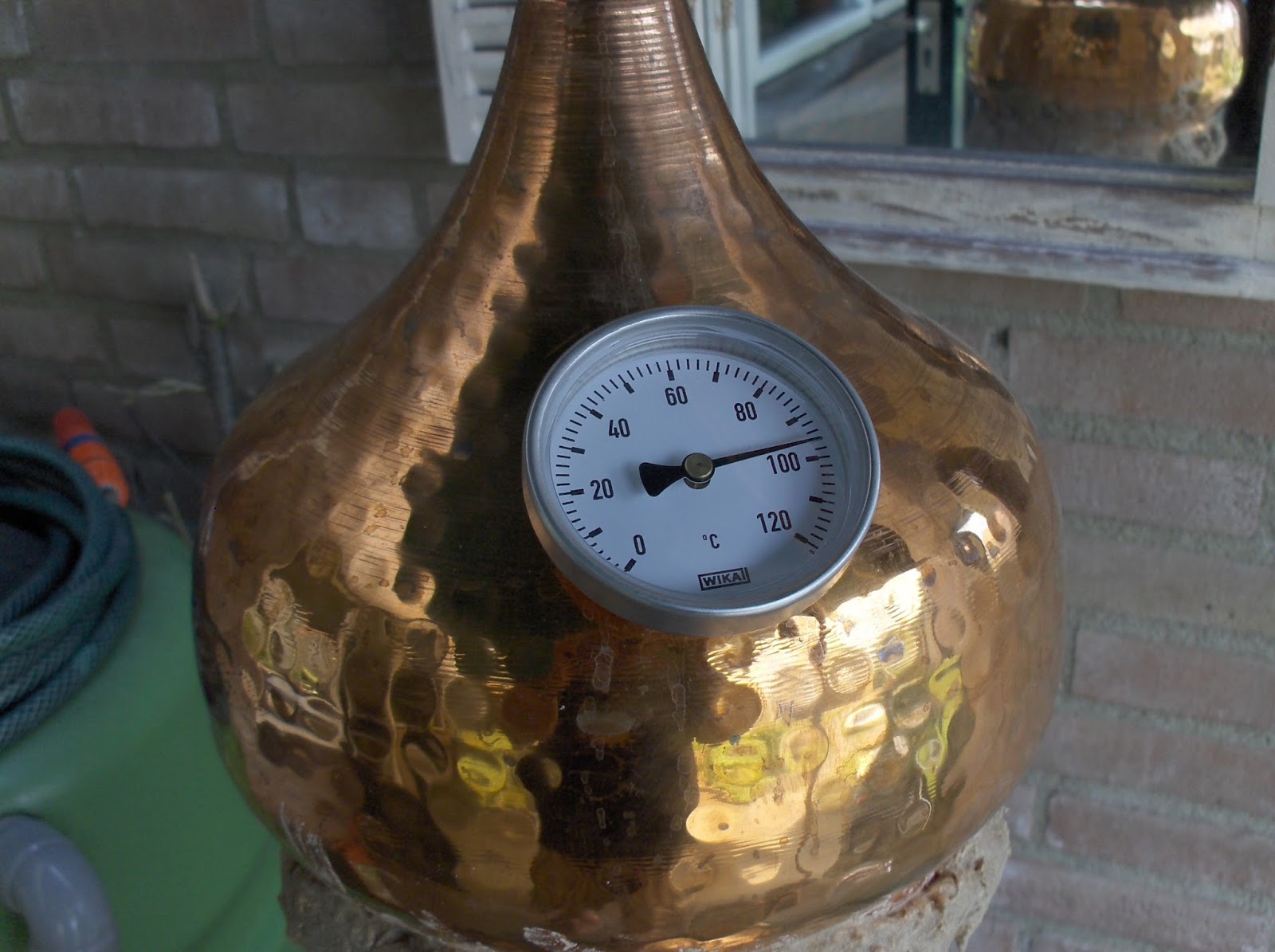
At 85 degrees Celsius the first drops of distillate came over. Lemon air was less but remained dominant. The temperature continued to rise during the distillation and fixed on about 96 degrees Celsius.
The hydrosol was remarkably cloudy. After 1 hour and 20 minutes distilling I smelled a baked-on vegetable scent and the hydrosol became clear. That seemed like a good time to stop the distillation.
citroenmelisse na de destillatie
The amount of oil that I that was collected in the separting funnel could be mentioned disappointing, but was expected. A total of three drops (0.15 mL) essential oil was recovered from,16 kg of oil from plants.
drie druppels citroenmelisse etherische olie
Maybe also explainable because the lemon balm was not really fresh when distilled. Erick and I have been in a delicious lemon air during transport from the nursery. That means that en route by touching and bagging plants there must have escaped some essential oil.
Lemon balm has produces the essential oil at the bottom of the leafs like as for example peppermint does in so-called oil-producing glands  With slight drying of the leaf will these microscopic glands tear and the plant loses its oil.
Lemon balm cuttings after one day
Yet this distillation has been valuable for me, though it was only for hydrosol. Jeanne Rose expert in the field of hydrosols describes it as follows:
This wonderfull fresh, lemonscented water is used for sensitive or aging skin, or spayed down the throat for many kinds of throat infections 

Tuesday, 13 August 2013

Making hydrosols


After having distilled herbs in glass for a couple of years, I decided in 2010 to purchase a copper alembic stil. The alembic with rotating column and a capacity of 20 liters, was large enough for distilling a reasonable amount of essential oil.

Demonstration distilling Eucalyptus: clogging the alembic with rye dough
The first year I have distilled lavandin, eucalytus and douglas fir. Sufficient for one or two small bottles of homemade essential oil to fill.


To separate the essential oil and hydrosol (condensed steam) I made use of a separating funnel of 500 mL. I saved all the hydrosols I had distilled.

                                                                   Cool bucket

The lavender hydrosol, made ​​of Lavandula angustifolia, appeared during the summer perfectly suited to deal with insect bites. I decided to contact aromatherapists to ask if they where interested in the hydrosols I had made    
Draining the hydrosol using a separating funnel
Then I searched and read a lot of information about hydrosols and their making.
An aromatherapist was interested in hydrosol of Scots Pine (Pinus Sylvestris).
Chopped pine in the column
To make a good quality hydrosol, the following issues are important:

Use fresh plant material
Distil slowly
Distil in a copper distillation unit
The ratio between the amount of plants and
the hydrosol has a maximum of 1:2
Disinfect the bottles which will be retained the hydrosol
Refrigerated hydrosol has a shelf life up to 2 years.

Used wine bottles for storage of hydrosols


The use of a copper distillation device is rather important to make a good quality hydrosol. The copper will be sure of eliminating the fungi, which benefits the sustainability of the hydrosol. And copper strikes sulfides down, which can cause an unpleasant odor in the hydrosol.
Distilling Scots Pine
                    
Where do you use the Scots pine hydrosol for?
The hydrosol is refreshing in the bath or sauna. It is used in skin care for men: the hydrosol refreshes and soothes skin especially after shaving. Use the hydrosol in a poultice to alleviate joint or muscle pain. Gives the space to breathe and is therefore good for lung patients.


Saturday, 27 October 2012

The lavenderproject 2012

This year I have harvested more lavender to distil than last year.
I had made an appointment with lavender farm lavender Plus Ulvenhout. In 2011 I had
 already cut some lavender from this farm.

 
Lavandula angustifolia var. little lady

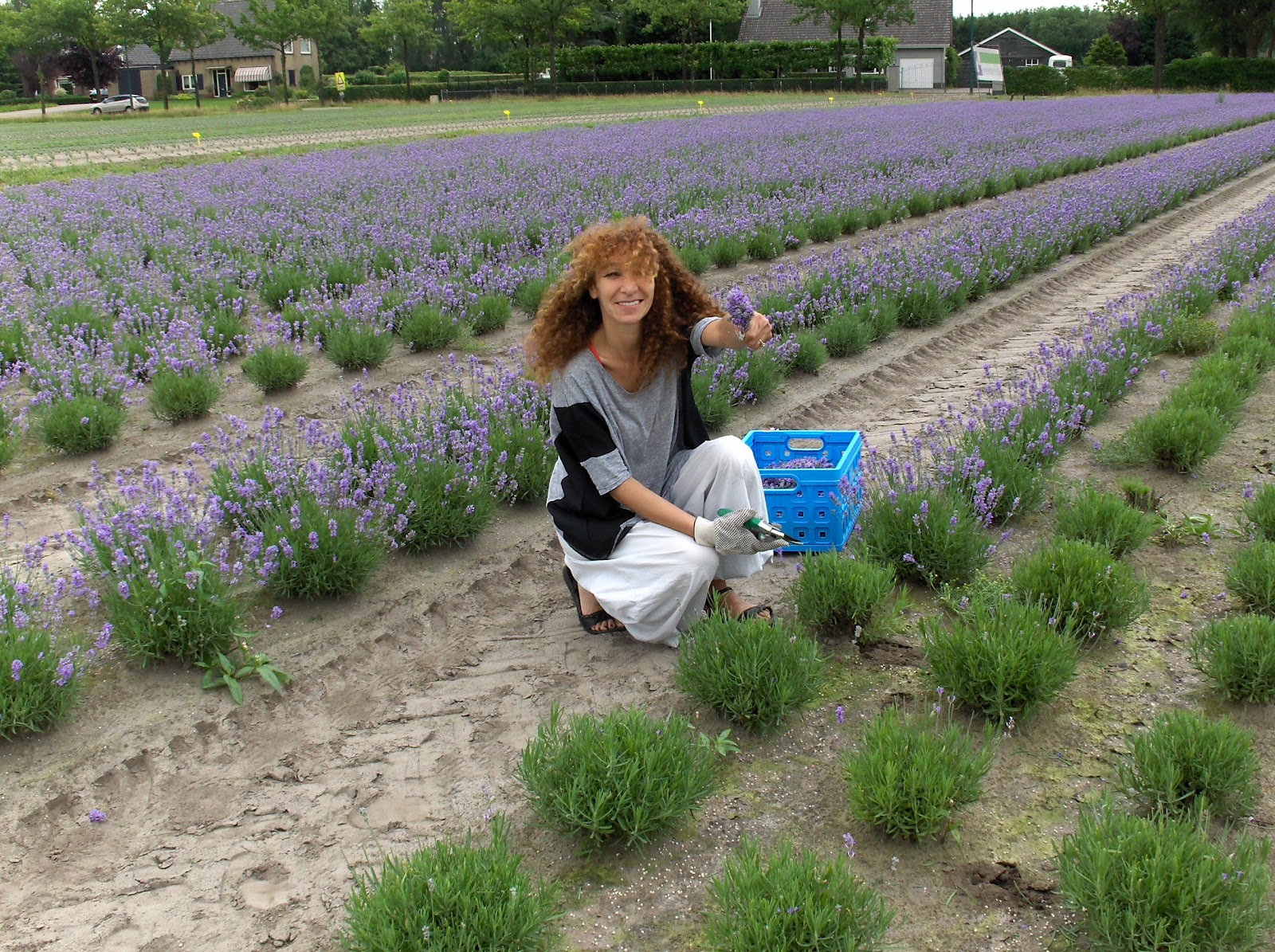
In late June early July it was just about the time of picking. This pickingtime is depending on the weather.
This year I needed some
volunteers to help me with this amount of harvesting lavender.

In exchange for an afternoon helping with the harvest they got a free workshop lavender distilling in August With the help of a local newspaper I had enough volunteers
Because during the picking no more than 8 people where allowed on the ground, I had to disappoint a number of people.
Friday June 29 and monday 2 july we started we harvested about 100 Kg lavender in totally.

This should be enough lavender for distilling 1 liter of lavender oil.
Thursday July 5 I started distilling the lavender harvest.

I have distilled 4 folding crates of the Ulvenhoutse lavender, Lavandula angustifolia var. little lady.

Freshly picked 4 kg per folding crate, so a total of 16 kg of lavender.
 florentine vase
During the distillation, I used a Florentine vase to separate hydrosol and oil. The oil was initially almost colorless as the distillation progressed and later became more yellow in color.
After 30 minutes of distilling
 After 60 minutes of distilling
After 60 minutes I paused the distillation to put the contents of the Florentine vase into a separating funnel. Because the separation capacity of the Florentine vase was reached.

After 2 1/2 hours distilling I stopped. Results: Approximately 140 mL lavender oil and 7 litre lavender hydrosol. The 16 kg lavender corresponds to a yield of 0.88%After distilling all the 100 kg's of picked lavender I reached an amount of total of 800 mL essential oil. That's a yield of 0.8%.

This year I wanted to know more about the quality of the lavender oil. Especially since there is little(?) lavender oil is produced in the Netherlands
Michel Vanhove ( www.nature-helps.com ) helped me with finding a French company that isspecialized in the analysis of essential oils. www.pyrenessences.com

This company has analyzed the composition of the oil  and checked whether pesticides were present in the oil. The latter is important, because the distilled lavender was not been organically grown.
The analyzes showed that there were no pesticides were present in the oil.The analytical methodology that has been implemented, gas chromatography, is extremely sensitive to very small quantities. The quality of the oil is, therefore, actually referred to as biologically.

                                                                                 gaschromatogram


soort stof
stofnaam
massapercentage
monoterpeen
Limoneen
2,11%
oxide
1,8 - cineol
5,75 %
monoterpeen
cis / trans ocimeen
6,78%
ester
oct-1-en-3-yl acetaat
2,15%
alcohol
linalol
19,45%
ester
linalylacetaat
22,17%
sesquiterpeen
beta-caryophylleen
2,32%
fenol-alcohol
terpineen-4-ol
11,18%
ester
lavendulyl acetaat
2,48%
sesquiterpeen
E-beta-farneseen
3,61
ester
geranylacetaat
1,59%
117 stoffen met een percentage lager dan 1,5%
totaal
100%


The analysis of the composition of the oil yielded 128 detected substances.
What is striking is that the composition of Ulvenhoutse lavender oil compared to other oils
contains less linalool and linalyl acetate , but is relatively high terpinen-4-ol content.


                       terpineen-4-ol

What do these analyzes tell about the quality of the oil? Because the composition is different the oil smells differently compared to French lavender oil from L.angustifolia. This Dutch oil composition has a unique character. In addition to the statement of the fragrance the composition also says something about the therapeutic value of the oil

For this I have asked an expert aromatherapist, Madeleine Knapp Hayes Wellhuner (www.levensboom.com), about the qualities of the oil in this composition. She has observed  the complete composition, because substances, even in a low concentration, can be of therapeutic value.
Madeleine: 
Linalool and linalyl acetate is somewhat low but the greater amount of terpinen-4-ol has a significant fungicidal activity. There is also a strong purifying influence of ocimene in the oil. A good oil in soap indeed, but I think there is also a calming influence. There is also quite a lot of myrcene. I would use this for wounds and skin infections, acne, aches ..

soap bars

With this recommendation and the amount of oil and soap which I had made, I was ready for selling some of it.
ready for selling!
I chose for selling my products in a large market (100 booths) on October 14th in Tilburg.

It was a success much interest and also oil and soap sold!
This lavender project was to me more than successful. Next year I will come back to the lavender grower to harvest again.